
Artist’s statement:
“I kept returning to one question: what actually changes during moments of enlightenment? Do the contents of the mind change? It feels as though everything remains the same yet is radically transformed. I wanted to create a space where the paradox is not explained away, but directly inhabited.”
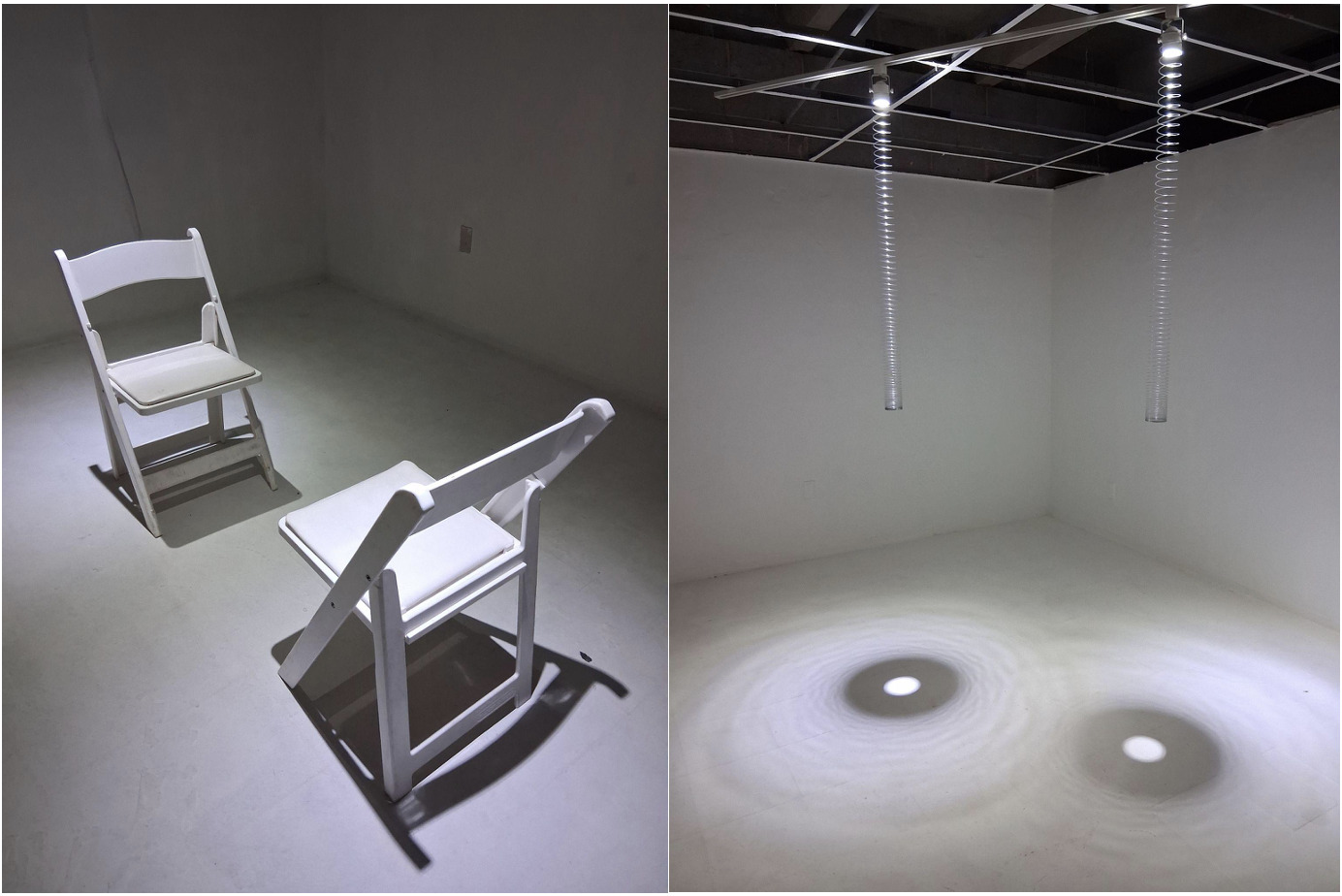
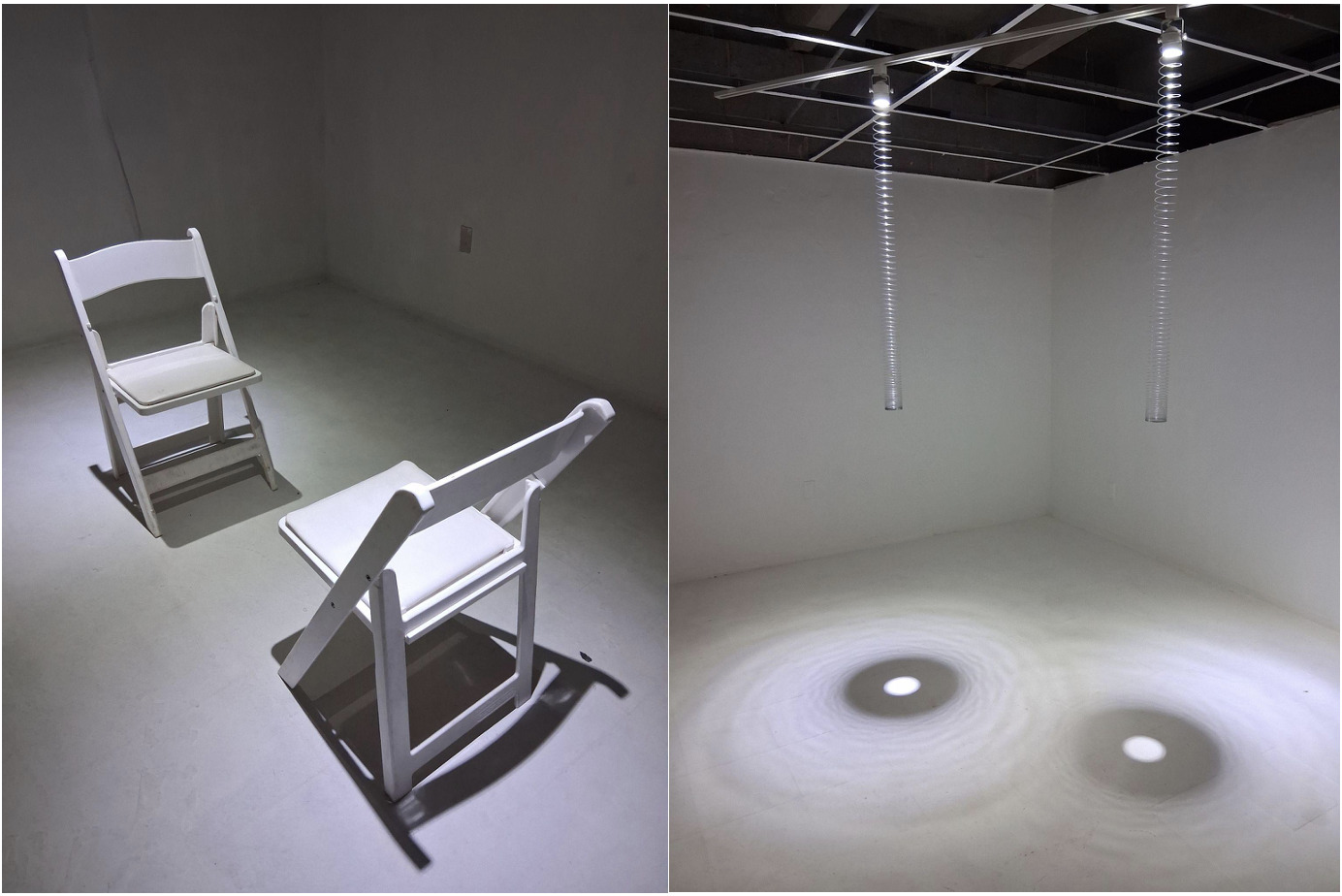
Elijah Arenas’ recent piece “Enlightenment: an Oak Tree (koan)” is a project of installment art exploring the idea of enlightenment as a shift in perspective. The piece is a sequence of seven rooms of alternating content: four rooms display two slinkies hanging from the ceiling, while the intervening three rooms have two chairs set up across from each other (pictures shown below). Throughout the space, peaceful music added to the unique experience.
As a piece of installation art, it is immersive, designed to be inhabited and interacted with by its viewers. The essential argument of the piece (as explained by an accompanying handout) is that experience of enlightenment contains no change in circumstance or in mental content, only a change in perspective. The question does not change, but our understanding of it does. The piece supplements this argument with the definition of a koan: a question not to be solved, but to be “inhabited”. Inhabiting the art piece is critical to understanding it: one’s understanding of the piece is simply a change in one’s perspective.
Below are parts of the handout that came with the piece, including a dialogue, the definition of a koan, and two images that represent the different rooms of the piece.
Dialogue:
Q. Could you describe this work?
- I have placed two slinkies in a room. One represents a mind before enlightenment. The other represents a mind after.
Q. Which is which?
- They are identical.
Q. Then how do I know which is which?
- You don’t.
Q. What is the other part?
- That you are looking at the slinkies.
Q. What should I be looking at?
- Whatever you are looking at.
Q. Nothing has changed between the rooms. The slinkies are the same.
- Yes.
Q. So the work is about perception.
- The work is two slinkies in a room.
Q. Do you believe anyone can experience enlightenment?
- I don’t know of anything that would prevent it.
Q. Not circumstances? Not background?
- The content of your life doesn’t need to change. Only how it is seen.
Q. Can this exhibit cause that shift?
- I couldn’t say.
Q. Then what is it for?
- To put two slinkies in a room and see what happens.
Q. And if nothing happens?
- Something is always happening.
"A koan is not a riddle.
It is a door that only opens from the inside."
“Koan: in zen tradition, a question or statement given by a teacher to a student - not to be solved but to be inhabited. A koan resists the intellect precisely because it was never addressed to the intellect. It is addressed to the part of you that already knows and is waiting to be asked.”
Elijah Arenas has described his work as an homage to another piece of art, called “An Oak Tree”, by Michael Craig-Martin. The above dialogue is inspired by the similar dialogue in “An Oak Tree”. The text of “An Oak Tree” takes the form of an argument that claims a change of contents; namely, that the glass is an oak tree. Conversely, Arenas’ piece concerned itself not with content but with perspective shift. Any readers curious about “An Oak Tree” will be satisfied by a quick google search.
“Enlightenment: an oak tree (koan)” invites viewers to interact with it. This interaction then yields enlightenment, which is not some new knowledge or idea, but rather a new way of looking at what is already there. Personally, it served as a frame for me to see my internal world better by inviting my emotions to fill the piece, in turn allowing me to see them differently. I had a bit of what one might call a “religious experience”: God reminded me that He was always there, face to face with me as though we occupied the very chairs of the piece. The handout was essential to helping me understand how to approach the piece: it was my first “enlightenment”.
“Enlightenment: an Oak Tree (koan)” is a fascinating contribution to the ever shifting creative landscape here at NMSU. As an installation piece, it offers the NMSU community a new kind of artistic experience and contributes to the broadening of our minds. Elijah Arenas’ piece does exactly what it aims to: it is a space we can “inhabit” and gain a new perspective. It invites other students to rethink their understanding of art and reframes popular understandings of enlightenment.